
Find Out How You Can Help Care for God’s Creation
The Creation Care Team was formed to discuss strategies on how we can respond individually and as a church to care for God’s creation and help our environment. If you are interested in joining them, please send a message to Creation Care at general@kentmethodist.com
OUR MISSION: United Methodist Christians are partners with God in protecting and restoring our environment. Creation Care Team will engage the congregation to transform the way we live in God’s creation by helping to bring change through education and advocacy in individual lives, local and global communities to be better stewards of the earth.
Creation Care Tips
Fall is in the air. Halloween will be here before we know it, and elections after that. Here are some tips to consider this autumn from the national Creation Justice Team of the United Methodist Church.
Research shows that just two hours a week in nature positively affects health and psychological well-being—and the benefit holds regardless of age, income, or chronic illness. Build nature time into your routine and your family’s. Take a 10-minute nature break, eat lunch outside, talk and walk. Love yourself and your loved ones. [As days get shorter, this outdoor time becomes even more important for our mental and spiritual health.]
Green space is critical infrastructure for health and wellbeing. And like all infrastructure, access to it isn’t equally distributed. Lower-income neighborhoods consistently have less tree canopy, hotter temperatures, more pollution, and worse health outcomes. Speak up for parks and trees to be placed so that all neighbors benefit.
When something proposed is harmful, raise your voice to connect the dots for people and officials about how the results are injurious. Encourage others to listen and act. Go after change. Turn your private frustration into public pressure. [Vote!]
Love for the next generation is the number one reason why people care about climate change. Keep in mind your children, grands, greats, [all those Trick or Treaters], and future generations as you make choices about your lifestyle and how you spend your energy addressing today’s environmental and justice issues. Be proactive for their sake.
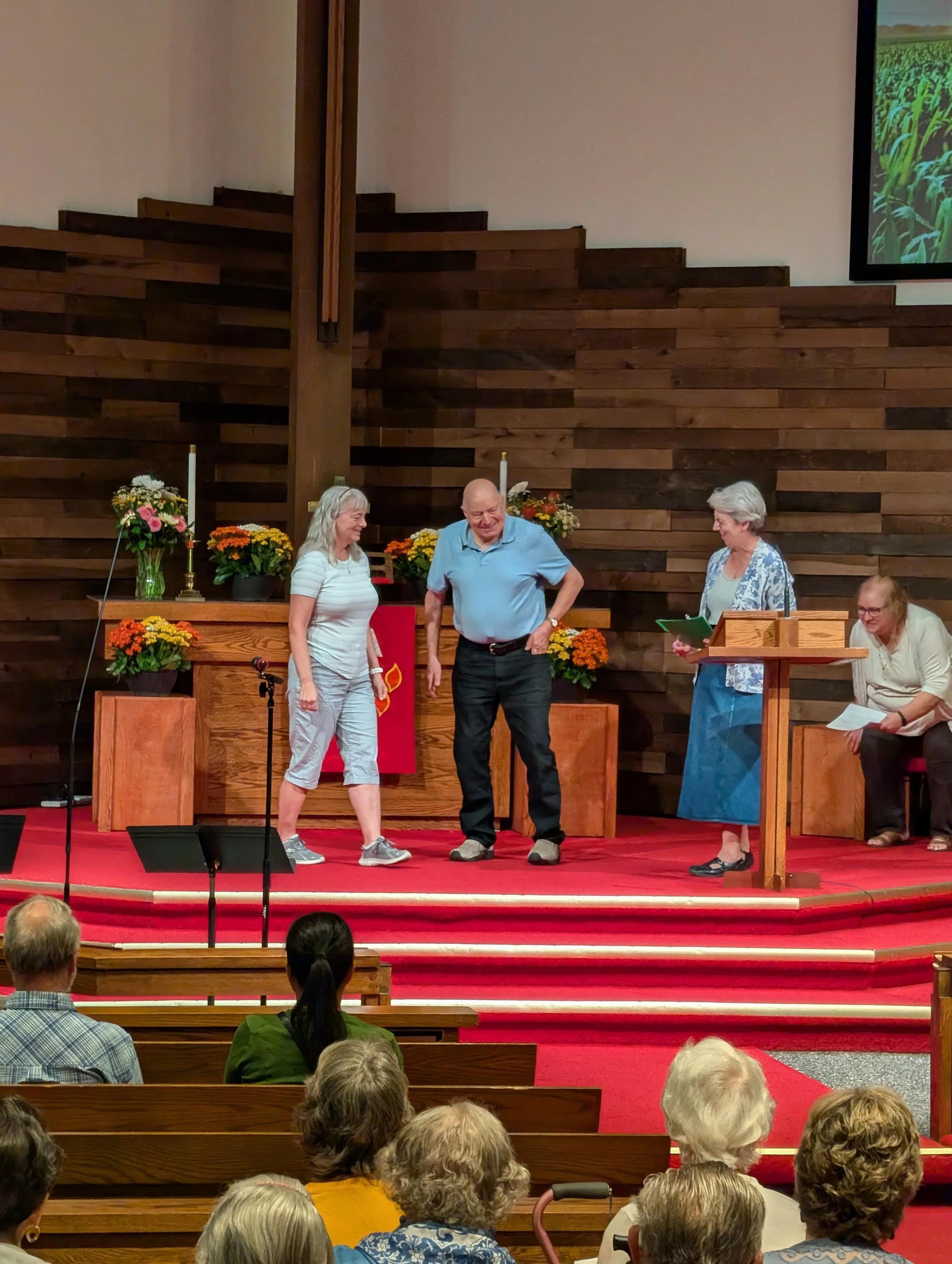
Summer Creation Care Hero
This quarter’s Creation Care Hero Award was presented to a well-deserving KUMC member, Gary Zink. You have probably seen Gary around church A LOT! He serves on the Trustees and leads the BMC (Building Maintenance) crew. This crew meets once a month to fix all those little problems that crop up from time to time. Things like cleaning the furnace filters or repairing seals on the windows or doors to prevent drafts. Gary also initiated our Capital Repair and Replacement Fund, so we, as a congregation, can be proactive in planning for repairs like our new sidewalk.
Over the past few years, Gary has worked to replace every light in our building with LED lights to save energy. You should have seen the organized spreadsheet of which lights were done and which were next to be replaced. Very impressive. He also helped us install our new bike racks so that folks can ride a bike to church. The heat pumps in the office were also Gary’s work, which help us save on energy costs and decrease our carbon footprint.
For this and so much more, we gave Gary Zink the Creation Care Hero Quarterly Award for the third quarter. Thank you, Gary, for taking care of our church like it is your home while keeping our impact on the environment in mind.
Thanks To Kent UMC, Kenya Will Plant 2,000 Trees!
All of us, including our Sunday School kids, donated $ 1,400 to plant 1,400 trees in Kenya to celebrate Earth Day at Kent UMC. WE acknowledged the benefits of trees and the need to reforest areas that had lost them. We noted that communities in Kenya have been adversely affected as crop yields have diminished, making their way of life unsustainable.
Climate Action Now, a national organization that advocates for and publicizes successful projects around the world and encourages the planting of trees in Kenya, Tanzania, and Mozambique, awarded us a 30% coupon, so our 1400 trees became 2000 trees!
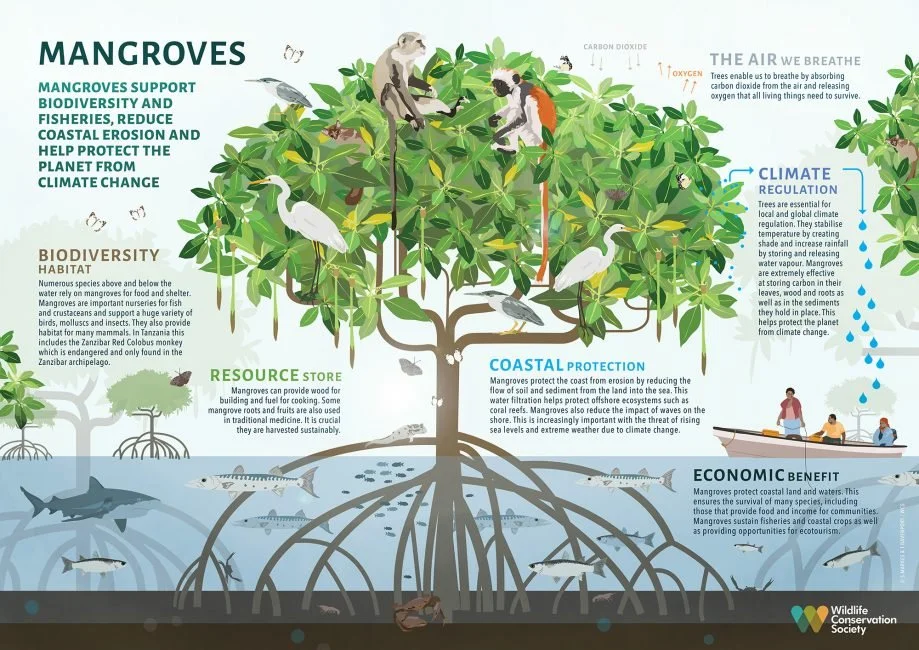
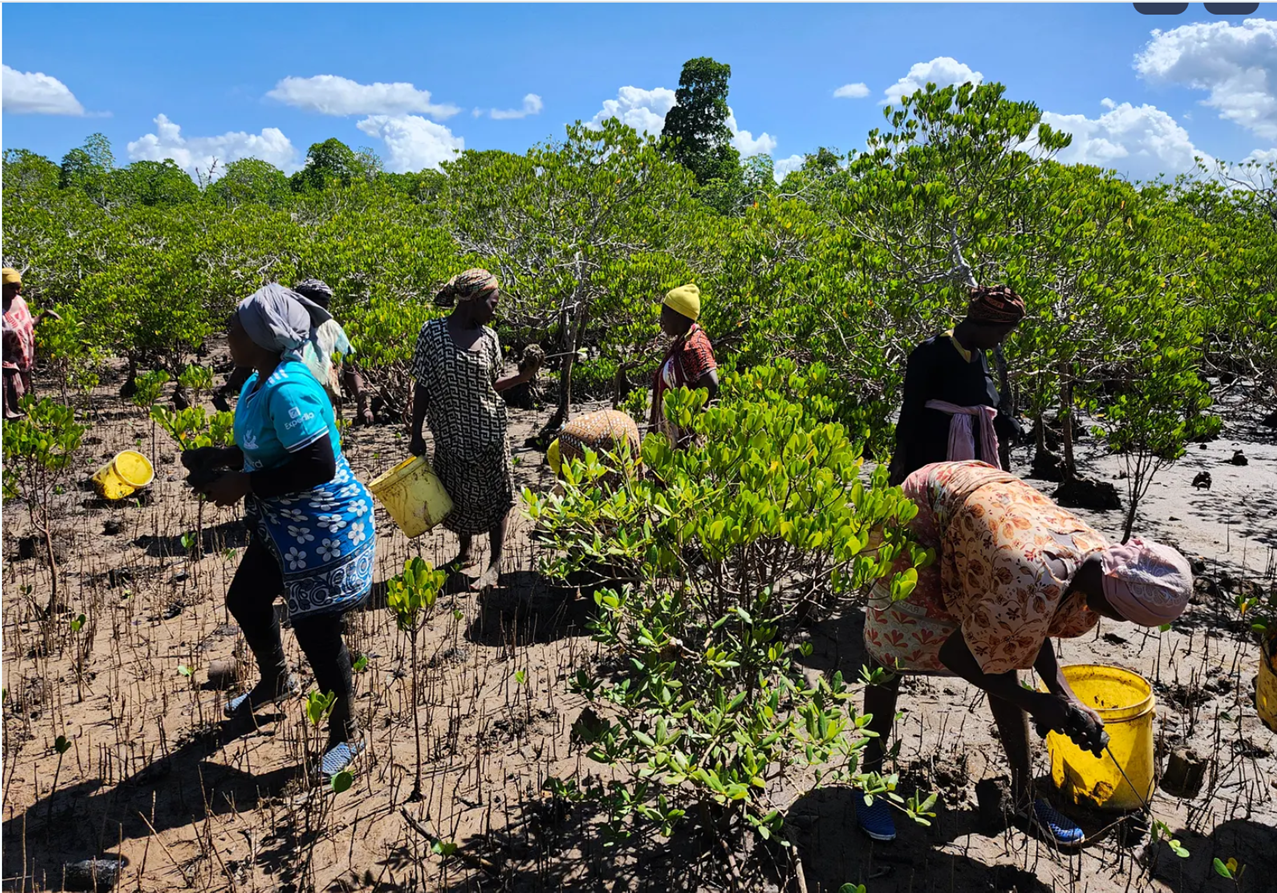
Recently, Sam from Climate Action Now (CAN) traveled to Africa and accompanied Earthlungs.org. This organization coordinates tree planting with the Kenyan Forest Service workers and ladies from a local community as they plant mangrove trees. Sam has been genuinely moved by the dedication and organization he’s witnessed at EarthLungs during his time in Kenya.
I’ve included excerpts and pictures from Sam’s notes. Although the trees they planted aren’t “our” trees, someday soon our trees will join them, and we can know the joy of affecting a positive change not only in a community half a world away, but also for our shared earthly home.
Thank you, Kent UMC, from the Creation Care Team, ClimateActionNow.com, Earthlungs, and the people of Kenya!
It’s quite challenging to come up with a more multifaceted, positive intervention for human and ecosystem well-being than restoring and protecting mangrove ecosystems.
Mangroves are defense-in-depth against physical climate disasters, acting as “shock absorbers” for extreme storms by providing wave attenuation and “living seawall” water buffering. Studies have found that storm surge can be reduced by as much as 50% simply by encountering the topographically complex structures of a mangrove forest, thereby reducing the potential area of flooding by hundreds or thousands of square kilometers. In addition to protecting against waves, their roots also hold soil and sediments together, reducing coastal erosion (and filtering pollutants from the land before they can reach, say, offshore coral reefs!). The mangroves of South Florida are estimated to have potentially prevented billions of dollars in damages from Hurricanes Irma and Ian.
They also serve as nurseries for biodiversity and local livelihoods. Little fish, both small species and the young of larger species, thrive in mangrove ecosystems because of all the spaces in the dense, wooded labyrinth where bigger fish can’t get in to eat them. A recent study calculated that mangrove ecosystems globally support an annual abundance of over 700 billion juvenile fish and invertebrates, and another study found that mangroves directly support over 4 million human small-scale fisherfolk worldwide.
About fifty people were working here in total, a plurality of them women from the local community hired as planters for the day.
Each month, our Creation Care Team offers a few simple ways we can change how we live to aid Creation. Here are a few you should consider.
Nespresso recycles pods for coffee. Our Creation Care Team Chair recycles these, and you can too. https://www.nespresso.com/us/en/order/accessories/vertuo/recycling-bag
Nordstrom Rack recycles makeup bottles and compacts through their Beauty Cycle Program. This program accepts:
Clean and empty packaging that fits Pact's collection guidelines.
Hair Care: Pumps, caps, closures, plastic containers smaller than a fist, squeezable tubes
Skin Care: Pumps, caps, closures, plastic containers smaller than a fist, colored glass bottles and jars, squeezable tubes
Makeup: Compacts, palettes, pencils, mascara tubes and wands, lipstick, lip gloss, applicators, squeezable tubes
1 Green Planet in Renton near The Landing recycles a myriad of things from aerospace equipment to DVD players and TVs to medical equipment, and so much more. Check them out at https://1greenplanet.com/what-we-take
Ridwell recycling picks up plastic film, multi-layer plastic, batteries, fabric/clothing, and special features (everything from Christmas lights to corks to medicine bottles) from your front door for a fee. Check them out at ridwell.com
Repair Economy website is a resource for where to get things repaired, borrow tools to do your own repairing, or get information on how to fix it, make it, or mend it. www.repaireconomywa.org

What is EarthKeepers?
You can probably figure out that EarthKeepers has a lot to do with saving the Earth, but EarthKeepers Training, Fall 2025, PNW, was that and much more.
Laura Osborn and Pat Gray from our Creation Care Team attended the training after completing 25 hours of homework, reading books, reflecting, and posting about what we read, engaging in self-reflection, and sharing a personal narrative with the group.
Creation Care’s qualifying project is to create a bioswale or rain garden to filter runoff from the east parking lot and direct it into the existing drainage pond.
We learned how to design our project with biblical support, find resources to support our work, and understand the role racism plays in environmental justice. We had the chance to meet with a coach to review our project plan and get input.
Runoff from our parking lot pollutes Puget Sound and harms salmon throughout their life cycle, particularly due to a preservative used on tires. Our rain garden will include plants that are important to our indigenous population, with appropriate signage to teach all who come to see. We plan to reach out to Daniel Elementary teachers to invite them to bring their students to observe and learn.
The training, from Oct 2 - 5, was led by Rev. Jenny Phillips, a native of Washington who is the Director of Environmental Sustainability for UMC Global Ministries. The trainings are held twice a year in various places around the United States, and ours was attended by 43 people, many from out of state.
We took a field trip to Vashon UMC, where a small, enthusiastic congregation has turned its church building into a resilience hub for its community and was subsequently awarded a grant to install solar with battery storage.
Then it was time to attend worship at Des Moines UMC, present our final project to the group, and receive our certificate and EarthKeepers pin.
On Nov 4th, 5:00 – 5:30 pm, Laura and Pat will be commissioned as EarthKeepers in a Zoom ceremony. Interested observers may access the ceremony at
https://www.facebook.com/GlobalMinistries
What an incredible program to inspire passionate members of congregations from all over who will take back knowledge and direction to their local churches! So proud to be a Methodist!
Creation Care Commitment
We, the Kent United Methodist Church, commit to continuing to reduce our carbon footprint, as measured by the EPA Portfolio Manager metrics, to attain the goal of becoming an Energy Star Building by 2030. The measurements include our use of electricity, gas, and water, as well as the disposal of garbage, recycling, and compost.
Energy Star Score for 2019—30 for 2022—43 for 2023— 59
Energy Star Target Goal: 75 by the year 2030
We are moving toward our goal! We CAN decrease our congregational carbon footprint!
-
-
Today was the second day of 90-degree summer weather here in Kent (August 12, 2025). The effects of heat go deeper than just feeling too hot. Here are some helpful tips for staying cool and being kind to God’s creation, including people.
From New Holland, Ohio, to New York City, communities are creating small parks and playgrounds. Research shows that proximity to trees and green space has numerous benefits, including keeping the air and temperatures cooler. Look at your neighborhood for potential pocket parks. Then speak up to your neighbors and local decision-makers.
As air temperatures rise, so do tempers. On hotter-than-normal days, nationwide, gun violence rises, robbing too many families of the lives of their children, teens, and parents. Work with others to identify “heat islands” and mitigate this justice issue. Plant a green oasis.
Air conditioners consume a substantial amount of energy to cool a space, resulting in increased greenhouse gas emissions. Ceiling fans, on the other hand, use minimal energy to circulate air and can make a room feel cooler without drastically reducing the temperature. Flip the switch to your fan.
Work with nature this summer to stay cooler. Shut blinds and drapes where the sun beats down; open windows at night; amplify that breeze with a window fan. Take a cue from siesta cultures, where many people work morning and later afternoon, chilling out during the hottest hours of the day.
Only seven states have laws to protect workers with outdoor jobs from extreme heat. Despite the dangers, others leave it up to employers to make the decision. Find out what safeguards are in place or not, and advocate for lifesaving policies. Seek justice for those who cannot speak up for themselves.
Cool your temperature by reconnecting with nature. With life’s hot pressures assaulting you, take time to be in God’s creation to gain perspective and renewal. Shade offers a 10–15-degree respite from direct sunlight.
-
To “come clean” usually means to ‘fess up about something not so good so that you can make a “clean break” and begin again in a more positive direction. Sometimes, the reveal comes from learning something new that sparks a desire to do better— for God’s sake. Perhaps these Tips will help you come clean.
Come clean with your washing machine. Older models use up to 40 gallons of water per load. With the Environmental Protection Agency (EPA) researching and upping the standards, newer machines use only 31 gallons. Front-loaders require only 13 gallons. If you don’t have an energy-efficient model, run only a full load each time.
Come clean without hot water. Switch to cold water for laundry and other wiping up. You’ll save energy and money on water heating, and your clothes and countertops will be just as clean.
Come clean without washing so often. Saving even one out of six loads of laundry will cut emissions. Imagine if everyone did that: The estimate is that with the 840,000,000 washing machines in use worldwide, the “Skip 1” practice would reduce energy emissions by 186 million tons.
Combine partial loads. You no longer need to worry about color fastness.
Come clean about personal care. Soaps, shampoos, and conditioners come in bars, which are better than bottles. Avoid single-use, forever plastics that trash God’s earth.
Come clean about scents. Scented laundry detergents release carcinogenic Hazardous Air Pollutants (HAPs) directly into the air through dryer vents, not to mention from the manufacturing source. Scented dryer sheets are other offenders. Use natural wool dryer balls instead. Buy unscented. It makes sense.
-
Some plastic is helpful. BUT…
The harm done by microplastics infiltrating our air, food, water, and even dust is increasingly recognized. Yet, recent rulings hamper the federal regulating bodies charged with public safety, and the fossil-fuel industry plans to expand plastic production.
We must protect Earth, our neighbors, ourselves, and our future and continue to work for change.
Here are some ways to THINK BEYOND PLASTICS
Chip away at the plastic habit. Switch from plastic to beeswax food wraps, bamboo toothbrushes, shampoo and conditioner bars, metal or wooden utensils, cloth reusable bags, and wooden cutting boards.
Look for natural food packaging—potatoes, corn, cucumbers, zucchini, for example—none need to be wrapped in plastic, which only goes to the landfill.
Your body was not meant to eat plastic in any form. Store and microwave your food in glass or ceramic—not plastic, which sheds microplastics for you to consume unknowingly. Take care of your health.
To reduce emissions from transporting heavy liquids, avoid plastic bottles. Instead, purchase tablets for laundry, dishwashing, and other cleaning products. Blueland and Dropps are two sources. Browse for others and read the “About” for their “greenness.”
Are you buying new clothes? Read the labels first. Polyester is plastic. Manufacturing the fabric requires 70 million barrels of oil annually and releases toxins into the air. Wastewater from washing polyester adds microfibers to waterways, harming marine life and those who like fish dinners.
Choose aluminum cans and real mugs over plastic bottles or throw-away beverage cups. Plastic does not recycle well—just 4–9% and only once. Aluminum doesn’t shed micro-contaminants like plastic; aluminum can be recycled repeatedly. Use a mug for coffee and other hot beverages, and avoid drinking microplastics and throwing away a cup.
Here's to a future BEYOND PLASTIC.
-
“But we’ve always done it that way!” Maybe so, but the more we learn, the more we discover that what we’ve taken for granted may need a second thought—a new way of looking at “it,” a new way of doing “it.” Being open to rethinking leads to growth. Consider that having “second thoughts” may be a God nudge for positive change.
Jesus said, “You have heard it said…, but I say unto you….”
Take a second to think before you print. How you use paper can save trees, which is essential for removing carbon dioxide from the air. Print two-sided; reuse paper with blank sides for scrap notes and printing drafts. Buy chlorine-free and sustainable paper with recycled, bamboo, or organic cotton fibers.
It’s time for second thoughts about secondhand. Things don’t have to be brand new to be just right. John Wesley taught and lived by “gain all you can, save all you can, give all you can.” Consider secondhand items and give them a second life. By being industrious and frugal, you are better able to care for both planet and people.
The intention of using balloons is to celebrate! But no matter what the balloon is made of, it is not biodegradable. It ends up as litter or in the stomachs of wildlife, killing them. Look for eco-friendly, creative, and reusable alternatives, such as festive paper lanterns, colorful felt bunting, fun bubbles, and more.
-
Of the many daily financial decisions you make—from the grocery store, to where you bank, to the stock market, to the vote—a number will involve choices about how you care for creation and what you do for justice. Be vigilant in evaluating seemingly small decisions. They can lead to big dividends.
Shop for the story. Websites make it easy to know the values and practices of a company, as well as their products. Read the “About” tab. When you purchase from a carbon-neutral or zero-waste business that focuses on sustainability and fair trade in their supply chain, from one that gives back to non-profit organizations that help heal the earth, you are making a difference. And
Divest: Get rid of “stuff.” Shed the burden of the consumerism mentality. Get rid of the identity of the consumer—one who uses things up—and choose simplicity and what’s good for the planet.
What you choose to use your money for makes a difference. Even small “investments,” such as purchasing organic food and non-plastic items.
-
After decades of promotion, “recycling” has entered the everyday language of most people.
In many urban settings, curbside pick-up is standard. Yet, recycling rates remain low, and landfills grow, degrading land and water, as well as the quality of life and property values of people without political power who live nearby—not by choice.
Reuse! Take your reusable bags to the grocery store, purchase a reusable water bottle, print double-sided, turn the backs of printed paper into scrap paper for notes, and switch from plastic cups to reusable mugs. Before you trash anything, ask yourself if it can be reused as is or repurposed for a new use.
Reduce! Buy in bulk to reduce packaging and emissions from shipping, whether to you directly or to the store. Choose “paperless” for bills and newspapers and reduce the trees cut down. Donate purchases that don’t fit instead of returning them because companies often send “returns” to landfills instead of restocking.
Refuse! Resist the constant pounding of advertising that says buy more and more. Say no to a plastic straw when out to eat and no to a bag for a few items you can carry easily. Reject products that include pesticides or are wrapped in plastic packaging.
Repair! Learn and use the simple skill of mending. Consult YouTube or a local hardware store for fixes for non-working appliances or gadgets. Refinish or touch up wooden furniture; recover chair seats with new fabric; fight for “Right to Repair” laws for your state.
Restore! Look for damage—a stream filled with litter, a beach area polluted with plastic, or a loss of trees from a tornado or fire. Reforestation accelerates recovery from a climate disaster. Organize for clean-up locally or contribute funds to reforestation efforts across the world.
Regenerate! On a personal level, compost your food and lawn scraps; participate in No Mow May, which helps bees and other pollinators; consider turning growth back to nature by rewilding at least a portion of your property. On a larger scale, examine your agricultural practices for changes that will regenerate soil fertility.
Rethink! We used to think of the earth’s benefits as endless. Earth is telling us we need to think again. If we want our children and grandchildren to live well, we need to support a more sustainable way of being now. Explore thrift stores before catalogs; purchase from environmentally conscious companies; buy from local farmers and merchants.
Review! Step back and look critically at your “stuff” regularly or at least annually. Are you a victim of “creep”? Have “wants” taken a higher priority than “needs”? Continue asking what else you might do to contribute to Earth’s health and give everyone a better future. Talk with family and friends about your insights.
Recommit! Keep learning, taking more steps, and talking to others about your actions on behalf of creation justice. The comprehensive and complex impacts of environmental issues can lead to anxiety and despair. Our children need to know we are doing something. Join organizations that are working for legislation and other changes. Watch for and celebrate good news. Persist.
Remember! Remember who you are and Whose you are: You are a beloved child of God. The very first commandment God gave humanity was to care for creation (Genesis 1–2). Remember that you are a caretaker in your approach to all things created by God and humans. Let that sacred charge be your guide.
-
Caring for God’s creation and being good stewards of our environment is an important value we share as United Methodist Christians. Following the leadership and encouragement of our Creation Care Team, the Administrative Council adopted the following motion at the January 11 meeting:
We, the Kent United Methodist Church, commit to continue to decrease our *carbon footprint” as measured by the EPA Portfolio Manager metrics to attain the goal of becoming an Energy Star Building by the year 2030. The measurements include our use of electricity, gas, water, and disposal of garbage, recycling, and compost.
A carbon footprint is the total amount of greenhouse gases (including carbon dioxide, nitrous oxide, and methane) generated by our actions.
This public commitment demonstrates our care and concern for what is happening to God’s creation. We show environmental leadership in our Kent community and the United Methodist Church.
The United States Environmental Protection Agency (EPA) established the EPA Portfolio Manager for businesses, commercial buildings, and, yes, worship facilities to measure the use of electricity, gas, water, and the disposal amounts of garbage, recycling, and compost. After plugging in the numbers, each organization is given a score, the goal being a score of 75 to become an Energy Star building.
Our metrics began in 2019 with a score of 30 and increased in 2022 to a score of 43. We anticipate another increase in 2023 due to our first full year of solar power. Our goal in 2030 is to attain a score of 75 to receive the Energy Star building award. Utilizing these EPA metrics helps us visualize where we need to make changes and hold ourselves accountable for the changes necessary to decrease our carbon footprint.
An Energy Star poster on the wall by the Youth Room in the Fellowship Hall shows our progress and some ideas to help us reach our goal.
Our decision to replace the old heater for the narthex and sanctuary will make a big impact, not only on our energy score but also on the amount of our PSE bill. Also, the United Methodist Men just finished vacuuming the registers in the narthex and sanctuary, and the Trustees plan to finish replacing all lights with LED lights by the end of 2024. We challenge each committee and group at KUMC to consider actions you can take to help us meet this goal.
But what can we as individuals do?
Turn off lights when you leave a room.
Use both sides of the paper.
Do not make unnecessary copies.
Unplug all appliances when not in use. They continue to draw power even if turned off.
Make sure you put used paper towels in the green compost bins in the restrooms.
Dispose of your paper plates, cups, and silverware in the properly labeled bins in the Fellowship Hall. Check the pictures above the bins if you’re not sure.
Check out this Creation Care page on our website for tips to help you make your impact, whether at church, work, or home.
Advocate for change for environmental stewardship with your vote and with your interactions at work or other groups.
All of us at Kent UMC need to keep this important commitment in mind to make the necessary changes for all creation: Earth, flora, fauna, and humans. From Genesis on, God calls us to care for and love creation. Martin Luther King Jr said, “The time is always right to do what is right.” That time is now.
-
Love in a Time of Climate Change, by Sharon Delgado. This book addresses the topic using the Wesley Quadrilateral and professes that love is the answer.
Saving Us–A Climate Scientist’s Case for Hope and Healing in a Divided World by Katherine Hayo, an evangelical climate scientist and the science head of the Nature Conservancy.
Church of the Wild: How Nature Invites Us Into the Sacred by Victoria Loorz
All We Can Save Truth, Courage, and Solutions for the Climate Crisis, edited by Ayana Elizabeth Johnson and Katharine K. Wilkinson. This is a positive take on a new paradigm.
Inconspicuous Consumption–things we can do by changing our buying
Braiding Sweetgrass, Indigenous Wisdom, Scientific Knowledge, and the Teachings of Plant, by Robin Wall Kimmerer, a young adult book
Nature's Best Hope: How You Can Save the World in Your Own Yard by Douglas W. Tallamy, for Young Adults and Adults.
What Can I Do? My Path from Climate Despair to Action by Jane Fonda
-
Batteries may provide peace of mind if an outage occurs. Through PSE’s Flex Batteries program, residential customers with batteries can also contribute to increased grid reliability and resilience by allowing their batteries to be called upon on days when the energy demand is forecasted to peak.
But we know batteries are expensive. Flex Batteries helps make batteries more affordable and accessible.
Residential electric PSE customers who have a limited income, are reliant on a medical device, or experience frequent outages may be eligible for up to $10,000 towards the upfront cost of a battery. Customers who enroll in Flex Batteries are also eligible for a one-time enrollment incentive of $1,000 (per battery) and an annual participation incentive of $500 for each year that they participate in the program.
More information on eligibility and qualification pathways is available at pse.com/flexbatteriesei
Questions? Contact DER@pse.com.
-
The Eden Reforestation Project plants many, many trees each month; this is tree planting on a large scale!
Not only does the project help the environment by planting large numbers of trees, and provides local communities with opportunities to become economically self-sufficient and earn fair wages. The project has planted 886,010 since September 2022.
Doing what we can to help our beautiful planet is very important to us, and so being able to fund the planting of trees is very exciting.
Find out more on the Eden Reforestation Project website.
Solar panel project
Kent UMC receives $102k Green Power Solar Grant from Puget Sound Energy
Our ribbon cutting was on Sunday, June 5, 2022. Read more about this project in these articles printed in the Kent Reporter and the Seattle Times.
Kent United Methodist Church is the recipient of a $102,000 competitive grant from Puget Sound Energy to fully fund the installation of a solar panel system. This project, spearheaded by the congregation’s Creation Care Team, is part of our overall emphasis on saving energy and reducing emissions from the church building. The team is leading the congregation in responding individually and as a church to care for God’s creation and help the environment.
In Partnership with
-
Len Whalen, with his extensive construction experience, has volunteered to be the lead liaison during the installation of this project. The design and installation will be completed by MAD Energy NW of Auburn, Washington, an organization that specializes in solar projects and certified Net Zero solar arrays. Kevin Charap, the project manager, has worked in clean energy since 2009. He has advised other grant recipients, including the Nisqually Indian Tribe. Kevin also happens to be a former member of Pastor Jim’s church in Wenatchee.
The project is expected to be completed in mid-spring. Kevin explained the solar panels will be placed on two areas: the southernmost slope of the roof (next to the playground), and on the “quad” roof (these areas have the best sun exposure). Solar panels are relatively reliable, requiring minimal maintenance (hosing them off and cleaning with a soft brush once a year). They come with a 30-year production warranty. Kevin noted that the frequent rain in the Pacific Northwest is a “self-cleaning benefit.” MAD Energy will provide training on cleaning and maintenance and will return after a year to inspect the system and make sure we are reaching our energy targets. As part of the grant application process, the roof’s life was assessed and it was determined that there is substantial life remaining.
Once installed, the system is expected to produce over 41,000 kilowatt hours per year, saving the church approximately $3,000 to $3,500 per year on PSE bills. The church will use all the solar energy it needs, and any extra power will go back to the utility grid, for our use on demand.
Puget Sound Energy is committed to supporting organizations that serve families and individuals in its communities. In this round the company, through its Green Power and Solar Choice programs, has awarded over $900,000 in total grant funding to local organizations in its electric service area to install new solar projects. The grant, funded by PSE’s Green Power and Solar Choice customers, brings local solar projects to PSE’s electric service area while providing support to grant recipients through lower utility bills for low-income or Black, Indigenous and People of Color (BIPOC) communities and the organizations that serve them.
Selection for this grant was based on providing vital support to those in need including low income or BIPOC communities and the organizations that serve them. KUMC’s commitment to outreach in the community, our diversity, and earlier efforts by the Creation Care Team were instrumental in being chosen for this grant. Our outreach efforts include support of our own Shared Bread program, Kent HOPE (emergency shelter for women and children), Catholic Community Services, NW Trinity Mobility Project, Kent-Meridian Hub, Atlantic Street Center, Church World Service Crop Walk, Kent Food Bank, Pediatric Interim Care Center, St. Stephen’s Housing Association (transitional housing), and our car camping program.
Earlier efforts to reduce our impact on the earth’s resources include a number of positive improvements, including double-paned windows, LED lights, heat pumps, WiFi thermostat for the sanctuary, timers on electric heaters, and recycling and composting programs. Additionally, the congregation hosts recycling events for the City of Kent in the church parking lot and has adopted their street for regular clean-up.
As a recipient of the grant, KUMC is aligned with PSE to solve several challenges at once: the installation of solar panels to support the expansion of cleaner energy and a healthier environment, lowering energy-related operating costs at the property and making the push to a more inclusive clean energy future. As part of our agreement with PSE, we will be sharing press releases and updates about the project, including a public “ribbon-cutting” ceremony when the project is complete.
The grant has also caused much excitement at the PNW Conference and Global Ministries of the national United Methodist Church. As you may remember, in April 2021, several agencies of the national United Methodist Church pledged to achieve net-zero greenhouse gas emissions across the organizations/ ministries, facilities, operations, and investments by 2050. They acknowledged that the UMC “has long affirmed our individual and collective responsibility to address the unfolding climate crisis.” In light of these values, the UMC said it was “called by our faith, informed by science, and led by our relationships with impacted communities” to respond urgently.
Special thanks are extended to all of those involved in this grant process, most especially Pat Gray, Kevin Charap, and Alex Woody who helped prepare the grant application.
Personal Steps to Protect God’s Creation
-
Find some helpful resources on some helpful resources on donating clothing and textile for reuse on this linke. https://couponfollow.com/research/saving-money-recycling
-
Find out more here on Grillo.com!
Find out more here on Avasflowers.net!
Additional Information is also available here on Drimmerusa.com!
You can also find lots of information on composting here on austinrealestate.com/homeowners-guide-to-composting.php
-
1. Create a "use-it-up" shelf in your fridge with all the foods close to expiration to reduce food waste.
2. Freeze fresh produce to ensure it doesn’t go bad before you can eat it.
3. Bring your reusable produce bags to the supermarket.
4. After you use your salad spinner, use the water in your garden or for your house plants rather than dumping it down the drain.
5. Wash and reuse your zipper-lock bags.
6. Prepare a menu for the week to avoid overbuying at the store.
7. Start composting—and you don’t need a big yard to do it.
8. Use a jar spatula to get every last bit of food out of containers and reduce waste.
9. Switch to a gentler multipurpose cleaning spray that is less harmful to you and the environment, or try an eco-friendly concentrate to reduce plastic.
10. Reuse parchment paper (up to 5 times!).
-
If we don’t recycle and compost correctly, they won’t take collect our cans:
NO PLASTIC BAGS in either recycling or yard receptacles, but compostable bags are acceptable in yard waste.
Also, no “clamshell” plastics even if they say they are recyclable, and when in doubt, throw them out!
We may get charged extra if we don’t follow these rules.
-
If you have a vegetable garden or like to take advantage of abundant fresh produce in grocery stores and farmer's markets, you will find some simple storage suggestions below to help prevent food waste.
On the Counter
These items are very sensitive to chilling injury and are subject to dehydration, internal browning, and/or pitting if stored in the refrigerator: Eggplant, Tomatoes*, Apricots, Kiwis*, Mangos, Peaches. *Move to the fridge once they’ve reached peak ripeness.
In the Front of the Fridge
These items are sensitive to chilling injury and should be placed in the front of the fridge, where the temperatures tend to be higher:
Corn on the cob, Peas, Berries, Melons, and Oranges.
In the Crisper Drawer
These items do best in the humid environment of the crisper.
Artichokes, Chiles, Green Beans, Hearty and leafy greens, Leeks, Scallions, Summer squash,
Lemons and limes (They stay juicier kept in a sealed container.)
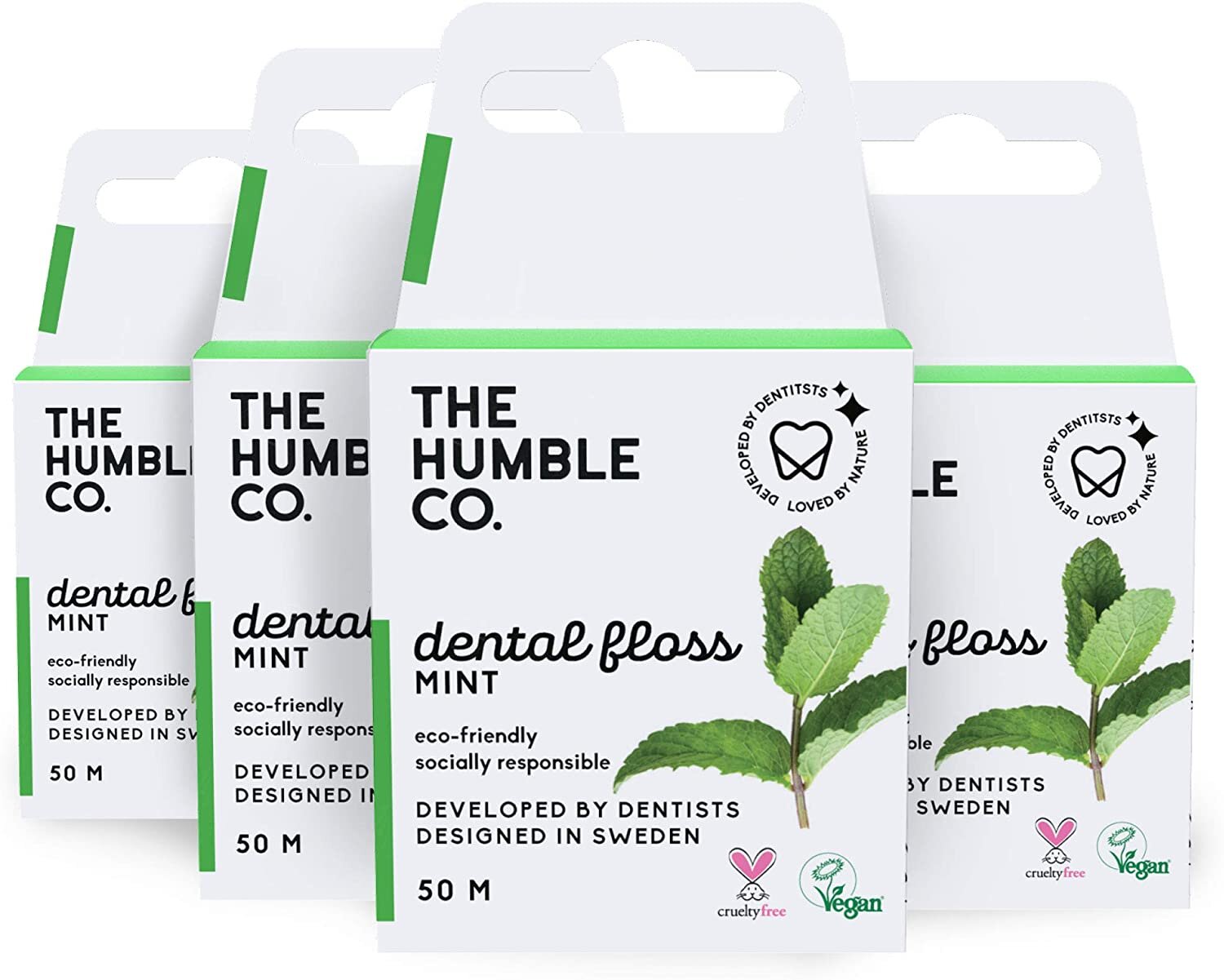
Sustainability Products—Limiting Single Use Plastics






The Impact of Climate Change on South King County
In the fall of 2020, some of our Creation Care members attended the City of Shoreline’s Climate Champions webinar series. All of this series was excellent. The session on Climate Equity Nexus though was particularly relevant to those of us who live in South King County. South King County is and will be disproportionately impacted by climate change as you will see in the presentation. In order to prepare for the future, we must be aware of the past and present dynamics that have brought us to this point in history. The webinar addresses this as well as the King County Strategic Action Plan on climate and what we as individuals can do. Though recycling and composting are part of the solution there is so much more needed.
Check out the webinar video on YouTube for more information.
Talking Trash with Tony Series
Watch our video series with Tony Donati, City of Kent Conservation Coordinator. tdonati@kentwa.gov
Tony Donati, City of Kent Conservation Coordinator, talks to us about how our church impacts the Kent Community.